

Navigating Management Resistance to Audit Findings
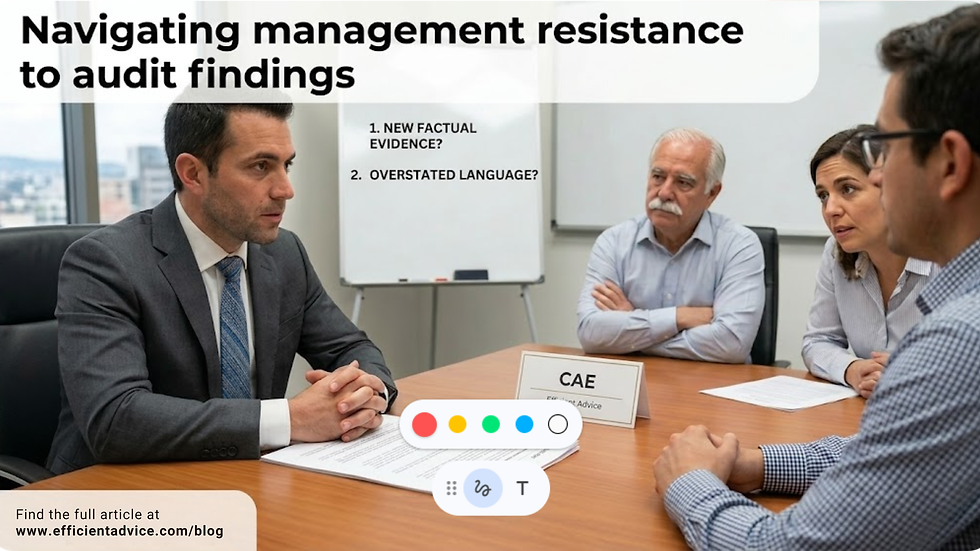
There is a distinction that most discussions of this topic blur: a finding being challenged on the merits is entirely different from a finding being challenged to make it go away. These two situations require completely different responses — and the CAE who can't tell them apart by the moment will consistently handle one of them wrong.
A challenge on the merits: When management challenges a finding with new context along with evidence that truly changes the situation, such as identifying an error or highlighting an untested control, the right thing to do is update the finding. This is about being accurate, not giving in. A CAE who refuses to update a finding as a result of new evidence is not defending independence; they are defending their own ego.
A challenge to make it go away: management expresses displeasure without providing new evidence, requests softer language lacking a factual basis, or escalates through organizational channels to apply pressure. In every such case, the right response is to maintain the finding — clearly, calmly, without intensifying unless the professional obligation to do so is triggered.
"The decision framework has three questions. First: has any new factual information been provided? If yes, update accordingly. If no, the finding stands. Second: Does the language overstate in a way a reasonable professional would view as unfair? If so, revise — because accuracy requires it, not because of pressure. Third: Does maintaining this finding serve a professional obligation that overrides the relationship cost?"
The escalation decision — when to take a disagreement to the audit committee — is the most serious version of this issue. Use it wisely. Prepare for it carefully, and never as a first response. Reserve it for findings where risk is significantly material, management's response is clearly inadequate, and the normal resolution process has been exhausted.
When you stand by a finding under pressure, you are not just defending that single finding. You are protecting the trust in your function’s conclusions. If you compromise that trust even once, every future finding will be taken less seriously. So, softening a finding today affects how all your future work is viewed.
WHEN PUSHBACK IS CULTURAL, NOT JUST ORGANIZATIONAL |
1. In Latin American workplaces, pushback on a finding often has cultural aspects that are not present in North America. Hierarchy is more obvious, so pressure from a senior executive can feel personal rather than just professional. The best response is to stand by your position while handling the relationship with extra care. Avoid giving in too much or being too blunt. 2. In Latin American organizations, face-saving is a normal and accepted part of the culture. If you present a finding in a way that lets the process owner suggest a solution rather than impose it, they are more likely to act on it. The audit remains strong; only the delivery has been adjusted. 3. In Latin America, escalation requires careful professional judgment. Escalating directly to the audit committee without first notifying the business unit leader can be perceived as a betrayal. Escalate with appropriate information and in the correct sequence to protect both the finding and your relationships. |
THE PUSHBACK DECISION — THREE TESTS BEFORE YOU RESPOND |
1. Before responding to any management challenge, apply the 24-hour rule: do not reply during the same meeting in which you experienced pressure. Request time to review the input thoroughly. This ensures your response is evidence-based, shows respect for management’s input, and reduces the risk of unfounded concerns. 2. Document every significant management challenge, including discussion points, evidence provided or omitted, your assessment, and your decision. This documentation demonstrates that your independence is based on evidence, not relationships. 3. After any major disagreement about a finding, reflect on three questions: Did I update the finding based on new evidence? Did I maintain any position that warranted reconsideration? Did I manage the relationship as professionally as the technical aspects? If you can answer all three honestly and confidently, you have effectively managed the situation. |
Worth considering: Stand firm on findings that matter, and update those that should be changed. Make sure you know which is which before you are under pressure, not while it is happening.


Comments