

Ten practitioner-grade white papers introducing the proprietary frameworks that define how internal audit functions validate AI output, govern AI use, and defend that governance to audit committees, regulators, and external quality assessors.
10
White Papers
6
Named Frameworks
En/Es
Native Billingual
LATAM
Focus
The White Paper Series
for Governing AI
in Internal Audit

THE SERIES
Ten White Papers. One Complete Governance System.
Each white paper introduces one proprietary framework, addresses one governance gap, and produces evidence that an audit committee, external quality assessor, or regulator can examine.
White Paper No. 1
The Six Ways AI Output Fails in an Audit Workpaper
Defines the six named failure modes — Fabrication, Confabulation, Precision Fraud, Certainty Inflation, Scope Blindness, Standard Drift — and the specific VALID Protocol detection step for each. The foundational white paper of the series.

White Paper No. 2
Why Audit Functions Using AI Have No Evidence of Output Quality
Introduces the VALID Protocol (Verify · Authenticate · Link · Interrogate · Document) and the eight-field workpaper notation standard. Defines the three layers of the validation gap most functions cannot currently close and the specific audit work required to close each one.
The Validation Protocol

White Paper No. 3
What the Audit Committee Will Ask About AI
The five questions every audit committee, EQA assessor, and regulator will ask — and the five evidence categories the CAE Evidence Standard requires to answer them. Provides the specific documentation the CAE must be able to produce on demand.
CAE Evidence Standard

White Paper No. 4
The AI Audit Maturity Ladder
Six evidence-based maturity levels from Absent to Leading — with diagnostic criteria, distribution data, and a practical advancement sequence from any starting position. Includes the scored baseline assessment methodology used in P1 engagements.
AI Audit Maturity Ladder

White Paper No. 5
Prompting for Audit
Why unstructured prompts are the biggest quality risk most functions have not identified — and the TRACE Framework's five-element audit prompt standard (Task Authority · Reality Brief · Actionable Output · Compliance Wall · Evidence Format) that closes the gap at the point of generation.
TRACE Framework



White Paper No. 6
The Invisible Compliance Exposure
How AI adoption without governance creates professional standards risk for the CAE — and the structured three-phase path to close it before the EQA, the regulator, or management arrives first. Introduces the 3D Audit AI Governance Model: Diagnose · Design · Defend.
The Invisible Compliance Exposure

White Paper No. 7
Auditing AI Systems
A five-domain audit framework for auditors without data science backgrounds: Governance & Accountability · Data Integrity & Lineage · Model Validation & Performance · Bias & Fairness Controls · Operational Controls & Human Oversight. Step-by-step procedures and common findings.
The P3 Module 5 Framework
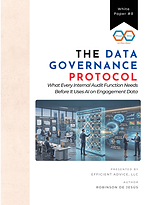
White Paper No. 8
The Data Governance Protocol
Eight behavioral rules governing what engagement data may enter an AI tool, how tools must be assessed and tiered (T0–T1), and what the function must do when data governance is violated. Includes the tool tier assessment framework and the prohibited data category list.
The P2 Governance Content

White Paper No. 9
Precision Fraud
The AI failure mode that looks exactly like real audit work. How language models generate specific quantitative figures — percentages, dollar amounts, exception counts — with no evidence basis. Includes the five-question Precision Fraud Recognition Test, the Compliance Wall prompt language, and the Supervisor Quantitative Review Checklist.
Audit AI Failure Taxonomy

White Paper No. 10
Building the AI-Ready Audit Function
The 90-day governance roadmap for CAEs starting from zero. Synthesizes all six proprietary frameworks and all five products into a single sequenced implementation guide — from ungoverned AI adoption to a complete, EQA-ready governance infrastructure.
The Full Series Capstone